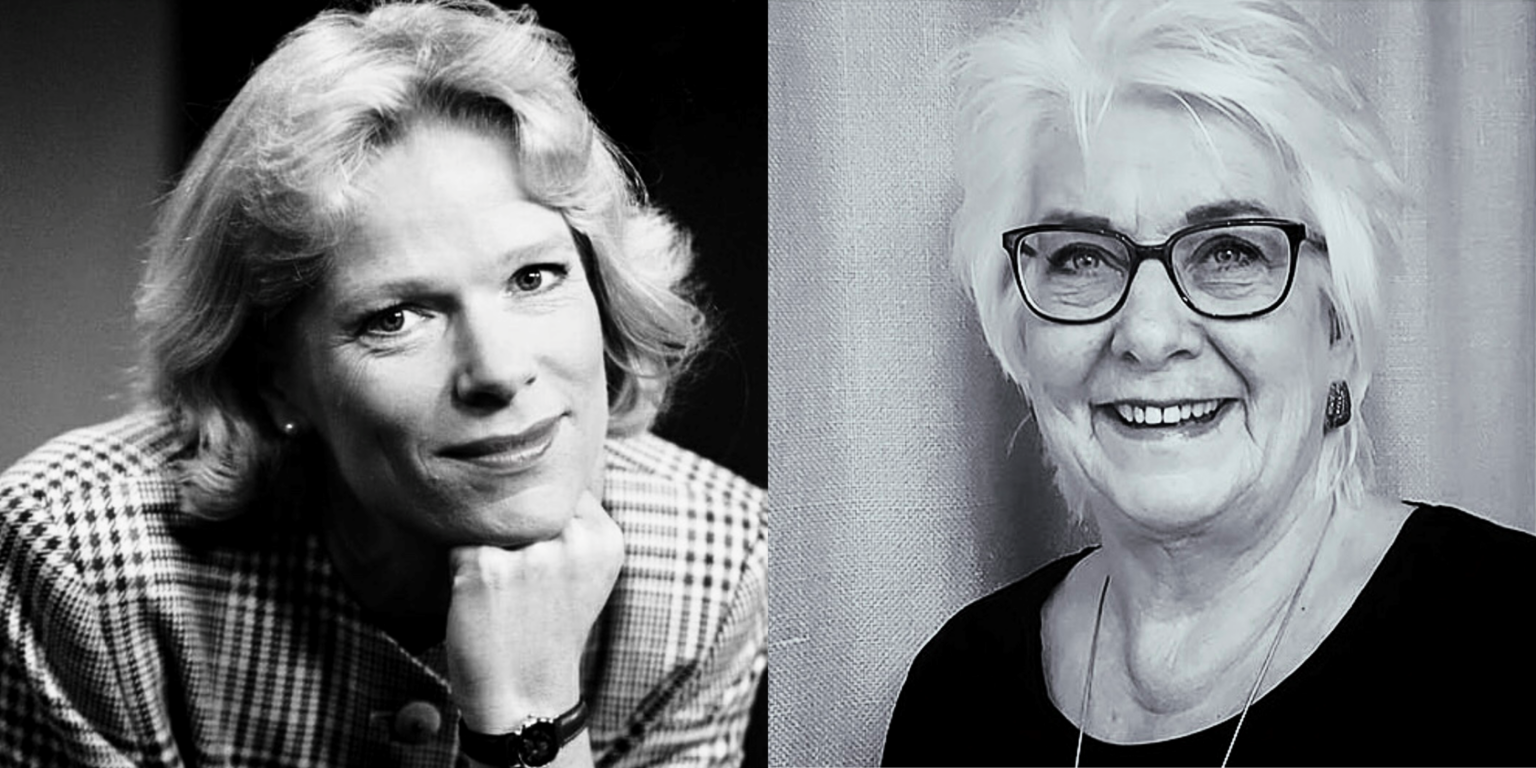
Ulla-Carin
Ulla-Carin Lindquist was born on the 2nd April 1953 in Kristinehamn. Her mother Margret was a dentist who had her own dental practice, and her father Bengt was a major in the Swedish Army. Ulla-Carin Lindquist lived in Kristinehamn while she was growing up. After having worked as a nursing orderly at a geriatric hospital she became interested in social questions, and started to study at the College of Journalism in Göteborg.
In 1977 she moved to Norrköping where she helped to develop local radio. There she met her first husband Ragnar Dahlberg, with whom she had two daughters, Ulrica and Carin. Ulla-Carin started working as a programme leader on a regional news programme, Östnytt, and in 1988 she was headhunted as a newsreader on the main national news programme Rapport. In Stockholm she met her second husband Olle Löfgren with whom she had two sons, Pontus and Gustaf.
Ulla-Carin Lindquist became one of the best known and most loved newsreaders. After having appeared on the screen for more than 10 years she took time off and moved to Montréal in Kanada, where she lived with her husband and sons for two years.
It was upon her return home from Canada in 2002 that Ulla-Carin began to experience muscular weakness in her hands. In the spring of 2003 she received the diagnosis ALS. During her brief period of illness she wrote the book Rowing Without Oars (Ro utan åror) in which she describes her life with ALS.
With the help of the producer Andreas Franzén and the photographer Pelle Wickman she made a documentary about herself and her illness. The film, My Race Against Time (Min kamp mot tiden) was broadcast on the 10th March 2004. Ulla-Carin Lindquist died peacefully the same day at her home north of Stockholm.
The Book - Rowing Without Oars
The book grew day by day
The same day that Ulla-Carin Lindquist was to celebrate her fiftieth birthday, on the 4th April 2003, she received the diagnosis ALS. In the late summer her colleague and friend Aina Bergvall wondered whether Ulla-Carin Lindquist should not write something that her children could get out and read later on in their lives. Ulla-Carin had already at that time written a little about her illness. Texts that she had never dreamed that others would ever be allowed to read.
Ulla-Carin jumped at the idea and continued to write. Aina contacted some publishers and was immediately given a yes by Norstedt’s. The director Svante Weyler wanted to publish it. Ulla-Carin was looking for answers to questions like: Why is there so little research being done on ALS? How can people who are afflicted be given even better help? What happens to a family that is told that Mummy must die – and die soon?
At the same time she used writing as a way of putting words to the feelings that were raging inside her. Three fingers of her left hand still obeyed her nerves. She lay in bed and collected her strength, was helped to her computer and wrote down the words she had already formulated in her head. As her speech became worse and her spoken words became fewer, so her written words grew in number. Day after day she sent off new text. Gradually two fingers had to take over the writing.
In the end only her middle finger wanted to work. For a long time it was only a small intimate group who were entrusted with reading. But since the book was first published in the spring of 2004 – Ulla-Carin Lindquist’s literary debut and at the same time her final work, as she herself expressed it – it has found its way to hundreds of thousands of Swedish readers. The book is also used as course literature on different nursing and care training courses. It has been published in a number of other countries too.
Rowing Without Oars has turned out to be be so much more than Ulla-Carin had dared to dream about. It became an international success, and an important contribution to the battle to increase the flow of information around and research on Amyotrophic Lateral Sclerosis.
Introduction to Rowing Without Oars
”This is where I begin and where I end. It is about my end. Not a memoir as one might imagine such a book. More like a diary of thoughts and quick flights into my memory, which I have written down. And a number of interviews and factual observations. ’Halfway’ through my life I have been invaded by a rare disease, amyotrophic lateral sclerosis, ALS. It has a fast and aggressive course. There is only one end: death. No cure. No recovery. What happens to a person in this situation? A year ago I was a full-time TV reporter. Today I cannot eat without help, walk or wash myself.I feel profound sorrow about everything I am not going to experience. I am devastated that soon I will leave my four children. At the same time I feel great joy and happiness about everything I am experiencing at the moment. Several times a day my house is filled with laughter. Does that sound strange?"
Kråkudden, January 2004
The Documentary
My Race Against Time
Ulla-Carin Lindquist took the initiative herself to making a TV documentary called ”My Race Against Time” which showed the course of her disease. The documentary appeared on TV for the first time on the 10th March 2004. It happened to coincide with the day that Ulla-Carin died, but the programme was broadcast as planned in accordance with her wishes. A large audience watched the documentary, which had been produced by Andreas Franzén, a reporter and good friend of Ulla-Carin’s and the photographer Pelle Wickman. The programme was nominated for the great TV-festival Prix Italia and it has been broadcast in several Norcdic countries.
Watch the documentary with English subtitles here »
Producer Andreas Franzén’s own account of how the documentary was made
The spring sun warmed the sudden small breezes in the little square outside the TV building that day at the end of May 2003. It was lunchtime. Some of the tables outside the great glass window of the TV café were occupied. At one of them sat Ulla-Carin with a few of our colleagues. When I went up to them to sit down everyone except Ulla-Carin got up to leave. I was almost offended and wondered what was going on. Anna Lena whispered that they were leaving so that Ulla-Carin and I could have a private conversation. That seemed to me to be fairly impossible because of all the people on the move around us.
However the two of us were to talk about something important. More accurately, she had something important to say to me. During the few lunchtime walks we had taken during the past months Ulla-Carin had of course told me that something was wrong. That one of her hands wasn’t behaving properly. That there were certain other problems. Medical examinations did not seem to be leading anywhere and there was great anxiety that something was really up the spout. We all knew that there were changes in her speech. A slight slurring that tripped over letters and sometimes whole sentences. Out there in the sunshine at the rather dull wooden table with a glass of water between us she told me what she now knew.
She had just been told what was wrong. I sat dumbly and looked at Ulla-Carin. We had known each other since 1976, from our youth until our mature years. Half a lifetime. Literally as it turned out. ALS. Nothing could be done about it. It was as bad as it could be. A death sentence in the spring sunshine, without tears but with strong emotions. Invisible, but felt clearly. She said calmly and unsentimentally: ”I would like to make a medical documentary about ALS. We could use me to portray the illness. And I also have a question: Would you like to make this programme? After a moment of silence I asked if that was really such a good idea. Quite apart from all the other strains she was also going to expose herself and her family to an intrusive film recording. I suggested that she think it over once more. It was a vain attempt on my part and I should have known it. She had decided to make something meaningful out of what was left of her life. This was part of the meaning. To the question of if I wanted to make the programme I replied yes. Nothing else was possible. And since Ulla-Carin differed from me in that she was not sentimental there was at any rate a good chance of success. Neither of us intended to make a ”weepy programme”.
When the decision had been made I had to find the other half of the team, the photographer. Somebody who was not afraid of personal, really hard stuff and who did not want to make a ”weepy programme about a well-known person” either. I asked Pelle Wickman. Pelle said yes. He might just as easily have said no. Pelle had worked for a long time in the same editorial office as Ulla-Carin but he did not know her personally. During our work together they grew to be close friends. Both were deeply professional, but they managed this anyway. Without the respect and appreciation that grew between them there would never have been any film. We started recording at the end of August 2003. The fact is that I have rarely laughed so often and so heartily as during that autumn. We all know how things went later. No words are right in such a situation. More than 2.5 million people saw the programme with repeats. Her first and last book appeared at the same time, Rowing Without Oars, which has been read by hundreds of thousands of people. ALS research received a tremendous amount of support through Ulla-Carin and lots of people found comfort in her way of handling her fate.
Andreas Franzén, Producer at SVT Stockholm